As a small WooCommerce plugin business with a sizeable customer base, we’re finally in a position to share some interesting insights into WooCommerce.
In this post, we analyzed 15,000 sites that were once WooCommerce stores to see what they look like today and how they’re moving into the future. Are they still running WooCommerce or have they moved to a different platform? What does a typical setup look like? Are sites adopting Blocks? We’ll try to answer those questions in this article!
The process & input data
As plugin sellers, we have access to a large list of websites that purchased one of our WooCommerce plugins at some point, meaning we know these sites were running WooCommerce in the past.
It gives us a good base to find out if store owners are moving away from WooCommerce, or doubling down on it.
We took the full list of URLs and cleaned it by:
Removing duplicates.
Removing development or staging sites.
Removing IP addresses and non-existing TLDs like .local.
Then we took a subset of 15,000 URLs — a meaningful size to process and gather insights from, even if it’s just 0.21% of the total WooCommerce market size (7M+ active installs according to wp.org).
There’s a chance we missed a few testing/staging sites, but in general, more than 10,000 URLs are for a root domain, so we’re confident our base list is large enough to track meaningful changes. Many subdomains are still valid installations, such as those using language prefixes or formats like store.domain.com.
Next, we got to work!
We wrote a small scraper that visits each URL in the list and extracts the information we need. No customer sites were harmed in the process — it involved just 2 quick HTTP requests to the homepage and cart page. The experiment was fully anonymous, and there’s no way to attribute any findings to a specific URL.
To help us make sense of the data collected, we built RowSpy, a desktop app that allows us to chat with our data through AI. It can generate answers, insights, charts, and dashboards, without ever pivoting a table or writing an Excel formula!
Okay, let’s dive in!
Store lifetime
The first thing we looked at, is whether or not stores are still up and running today. If a site can no longer be reached, it’s safe to say this business is no longer operating.
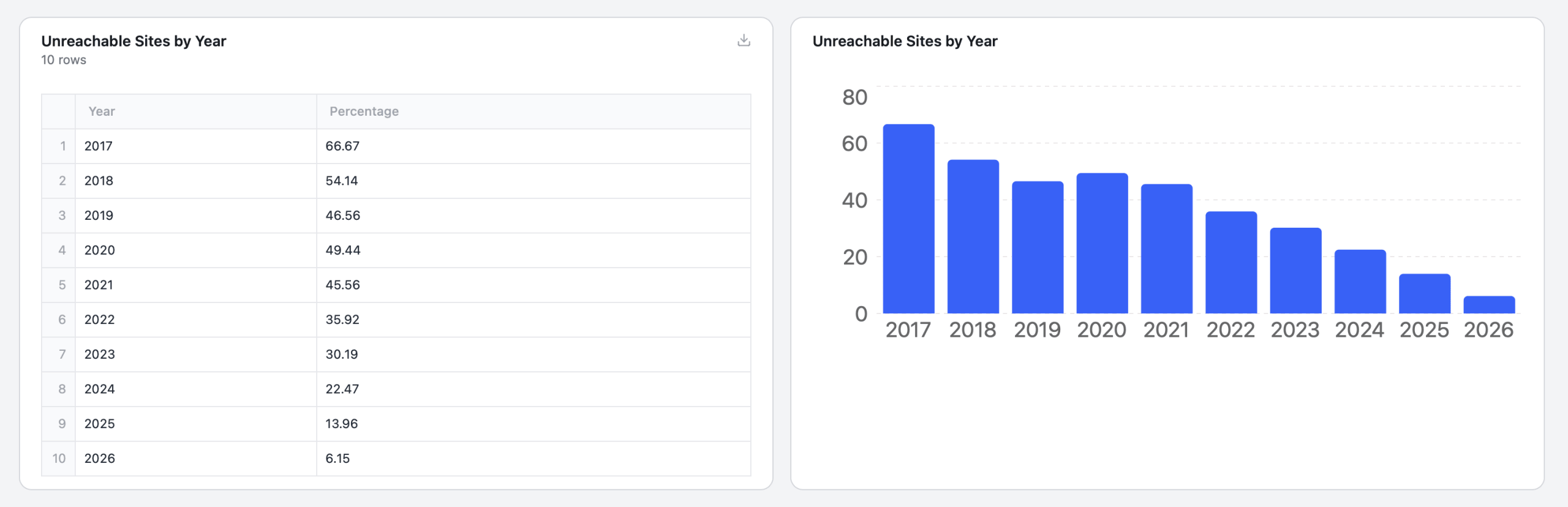
Out of 15,000 sites, 32% (4,819 sites) can no longer be reached. Sites are considered unreachable if they return one of the following:
A 403, 404, or 410 HTTP error.
A 5xx HTTP error.
A 200 HTTP error with a maintenance plugin active.
We didn’t count ambiguous cases, like sites using Cloudflare or WordFence to block access.
We included sites in maintenance mode as “unreachable,” because many appear to have been in that state for a long time. It’s likely these sites are no longer active, with maintenance mode being an easy way to take a site offline without losing the work. 167 sites fell into this category, so the ambiguity is minimal.
Grouping sites by the year they were created (well, when the store owner bought one of our plugins!), we see that one third (36%) of the sites active in 2022 is no longer online today.
It sounds like a lot, but perhaps this is just the reality of running an online store? It would be interesting to compare this to stores on other platforms!
WooCommerce can be a low cost way to test an idea, and this could explain why so many sites don’t make it past the 3-to-5-year mark.
Sites moving off WooCommerce
Next, we looked into the remaining 10,181 websites still running today. We wanted to find out if they’re still relying on WooCommerce or if they’ve moved to other platforms.
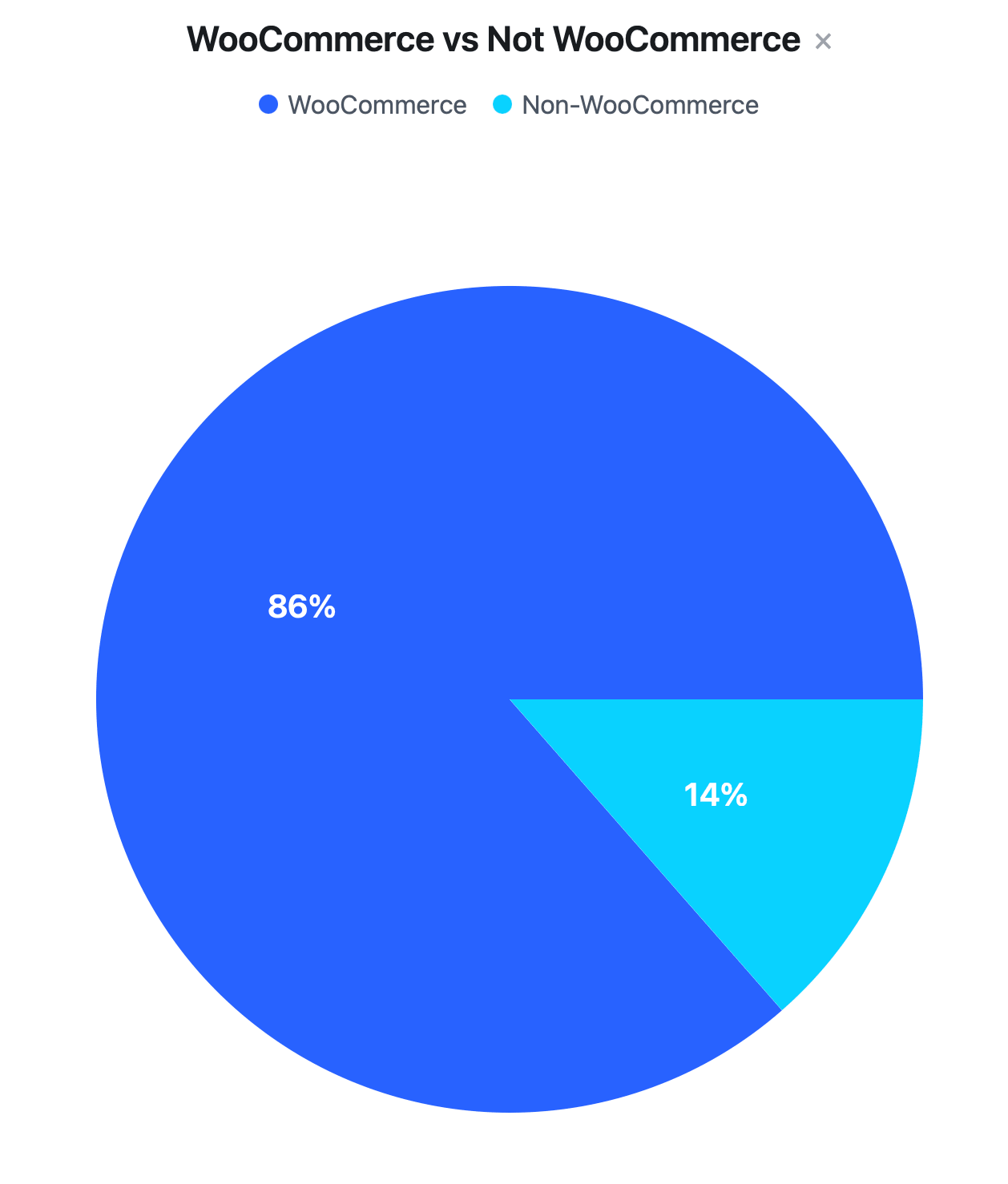
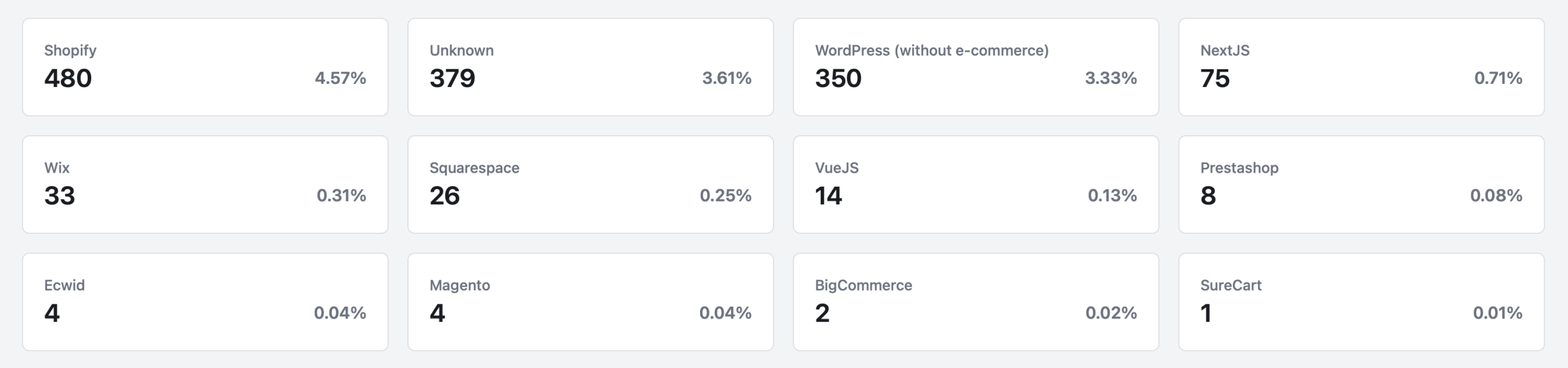
In total, 14% (1,380 sites) moved away from WooCommerce. Here’s where they moved to:
4.6% (480 sites) moved to Shopify.
3.6% moved to an unknown platform. That’s either a local ecommerce solution tailored to the shop’s country (such as Cafe24 in Korea), a custom build, or a platform we couldn’t detect.
3.3% moved off WooCommerce but still use WordPress. These sites dropped WooCommerce in favor of a more lightweight solution (such as a custom order form) or no shop at all.
Interestingly, almost 1% moved to a platform powered by NextJS. These sites honestly feel snappy!
33 sites moved to Wix and 26 sites to Squarespace.
A handful of sites moved to other larger platforms like Prestashop, Magento, or BigCommerce.
1 site moved to SureCart. I expected this number to be higher.
It’s no surprise that Shopify is WooCommerce’s biggest competitor. Honestly, I expected the number of stores moving to Shopify to be higher. Spend enough time on Reddit and you’ll come across plenty of stories about store owners making the switch, so 4.6% is a bit lower than I expected!
If the same move happens from Shopify to WooCommerce, the overall user-base remains unchanged.
A more worrying trend is probably that new store owners may be choosing Shopify over WooCommerce from the very start.
That leaves us with a dataset of 8,801 WooCommerce sites to check for further insights.
Site speed
It’s no secret that WooCommerce sites can feel slow. While that’s not entirely WooCommerce’s fault, store owners often notice this, and direct their frustration at WordPress or WooCommerce.
Especially DIYers often don’t know how important it is to choose good hosting and performant plugins (ahem, we care *a lot*). Add a page builder on top, and you’re already half a second behind!
For each site, we measured the TTLB (Time to Last Byte) of the home page. It isn’t the same as a full page load in the browser because we didn’t download any extra assets like images, scripts, or CSS. But it still provides a good indication of overall site performance.
Sites using WooCommerce have an average TTLB of 1,782 ms, compared to 848ms for sites not using WooCommerce or WP.
That’s a 110% increase! Massive difference!
Of course, this metric needs plenty of nuance: the WooCommerce sample is ten times larger, and the test location may not reflect the sites’ actual audience.
But the numbers confirm what we already know: WordPress/WooCommerce needs a lot of special care to keep it fast and snappy and, honestly, store owners shouldn’t have to wrangle with that from the get-go.
Block vs classic checkout
The team at WooCommerce has been working hard on their Blocks Collection in recent years. These blocks promise store owners an easier way to create and edit key pages like product listings, the cart, or checkout.
Since WooCommerce 8.3, Blocks are the default experience for new stores. This means if you install WooCommerce today, the store’s default pages are using blocks (you can always go back to the familiar shortcodes).
We like the idea of blocks! In the past, users had to rely on plugins or themes to make style changes to key parts of WooCommerce. Blocks offer more of a page-builder experience, letting you easily adjust the appearance through settings.
At least, that’s the idea in theory…
In practice, blocks are still quite limiting, and you can’t really change all that much. They’re also built in a new technology with lacking backward compatibility, so many plugins and themes can’t fully integrate with them yet.
We looked at how many stores are using the new block-based cart. Out of all sites, we were able to detect a cart page on 7,197 WooCommerce stores.
Not every site exposes a cart in a way we can find—some skip it entirely.
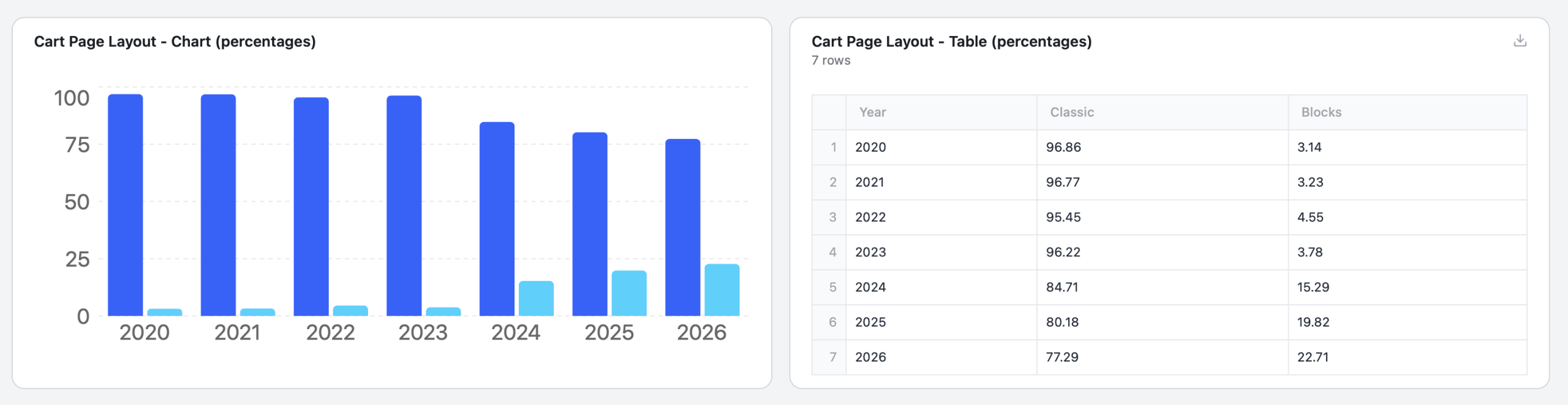
Block usage is only at 12%. The lack of adoption is definitely because of the above mentioned constraints!
This isn’t a totally fair comparison, though. The cart & checkout blocks only officially rolled out in late 2023, and older sites are less likely to update (I bet store owners don’t like to touch a working system).
When we look at block adoption per year, we can see a clear increase after 2023:
20% of sites that were created in 2025 (well, they purchased one of our plugins) used blocks, and this number is already higher in 2026.
If we adjust the overall percentage till after the launch of WooCommerce 8.3, we get a slightly different view:
Now, 18% of shops use the block-based cart page.
While these numbers are increasing, it’s still fairly low considering it’s been the primary focus of development for the past 8 years. I think we’d see a larger push if themes leaned into blocks a bit more.
I’d also be curious to know how many stores switch back to the legacy cart in the future due to plugin conflicts or simply because they can’t achieve what they need with the blocks.
Install figures
There’s some other interesting information we can share around the average WooCommerce installation:
On average, a site uses 30 plugins. We find this quite high, and it shows you do need a lot of extra software to make your WordPress site work well for you. The top 3 plugins (aside from WooCommerce) are:
Elementor or Elementor Pro on 48% of the sites.
Yoast SEO on 39% of the sites.
WP Mail SMTP on 28% of the sites. I’m a bit surprised by this choice and would argue people can select a simpler plugin with less intrusive footprint.